As liberal author Helen Pluckrose makes clear the illiberal postmodernist left's shift from radical skepticism to radical certainty (i.e., dogmatism) was -- for the rest of us -- a push from the frying pan into the fire.
Monday, January 31, 2022


Sunday, January 30, 2022
Free Speech -- What Is it Good for? Absolutely Nothing?
It is worth emphasizing that Enlightenment liberals have placed at the very top of their list of desiderata an institution explicitly intended to detect and correct their errors: namely, the free marketplace of ideas. By opposing free speech, the enemies of liberalism reveal that they can't even imagine ever needing correction, and they act accordingly, preferring smears to rebuttals.
Saturday, January 29, 2022
Boomerang Argument
Any argument against a totally free society that depends on the dark side of human nature inevitably circles around to hit the one making the argument smack in the back of the head. Hence, it is a boomerang argument. The reason is that if people are so bad that we can't trust them with total freedom, then how can we possibly trust anyone with monopoly political power? The answer is we can't. Statelessness is the ultimate in checks and balances, which liberal devotees of the limited state claim to value.
Friday, January 28, 2022
TGIF: Anti-Woke Isn't Necessarily Pro-Liberty
I had a reminder this week that those who oppose fashionable postmodernist-style attacks on reason and objectivity, such as "critical" race and gender theories, are not necessarily consistent friends of liberty and the free society.
That reminder came in a recent video commentary by Dave Rubin on a year-old speech by Homeland Security Secretary Alejandro N. Mayorkas before the U.S. Conference of Mayors. What upset Rubin so much that he had to play the video clip several times was this statement from Mayorkas: "Unlawful presence in the United States will alone not be a basis for an immigration enforcement action...." Mayorkas said more (hence my ellipsis), but that's all that Rubin drew attention to. (I'll cover the rest in a bit.)
Here's what Rubin had to say in reaction:
How insane is that?.... We are literally saying, "If you are here illegally, but you don't do anything bad, we just ain't gonna do anything about it." That's not how a country is run. Dare I quote that orange guy, who said, "Without borders you don't have a country"? Well, that's pretty much where we're at at this point.
So what's wrong here? Quite a bit, actually, so it's tough to know where to start. It tells me a lot that Rubin's cognitive system -- the part that chooses words and phrases -- isn't set up to avoid suggesting that anyone could or should run our country. Think about that phrase. To quote Rubin, "How insane is that?" We shouldn't want anyone or any group to even try to run the country (no matter how that is defined) because even though the effort would fail, the attempt would inflict a lot of pain.
Why doesn't Rubin know that a free society (which he says he wants) runs itself -- it's a bottom-up, emergent, undesigned order -- when the politicians and bureaucrats leave it alone, and it does so better than anything the politicians and bureaucrats have come up with? Dave, read your Thomas Paine, whom I quoted recently and will do so again:
Great part of that order which reigns among mankind is not the effect of government. It has its origin in the principles of society and the natural constitution of man. It existed prior to government, and would exist if the formality of government was abolished. The mutual dependence and reciprocal interest which man has upon man, and all the parts of civilised community upon each other, create that great chain of connection which holds it together. The landholder, the farmer, the manufacturer, the merchant, the tradesman, and every occupation, prospers by the aid which each receives from the other, and from the whole. Common interest regulates their concerns, and forms their law; and the laws which common usage ordains, have a greater influence than the laws of government. In fine, society performs for itself almost everything which is ascribed to government.
As to Trump's dictum that you can't have a country without borders, Rubin might want to give that another thought because maybe that definition of country is unnecessarily narrow. On the other hand, if we accept that notion of country, maybe we'd opt for something else after closer consideration.
Rubin and the orange guy beg this question: What kind of society do or should we want? They assume that virtually everyone (or everyone who matters) already agrees on the answer even though that is what needs to be discussed explicitly before we decide. (That's how I still understand the phrase beg the question.)
As the political philosopher Chandran Kukathas points out, "border control" is not really about controlling borders. It's not even mainly about controlling immigrants. Rather it's about controlling citizens. You can't restrict immigration without restricting the peaceful activities of those identified as citizens. That identification process is based on contingent political decisions made by fallible, vain, and even corrupt rulers; it is not a metaphysical process conducted by high priests. (See Kukathas's book Immigration and Freedom.)
Kukathas writes:
[T]he threat to freedom comes not from immigration but from immigration control…. Immigration control is not merely about restricting border-crossing but as much, if not more, about constraining what outsiders might do once they have crossed the border in a society. But it is difficult to control outsiders without also controlling insiders, since insiders are all too ready and willing to hire, teach, rent to, trade with, marry, and generally associate with outsiders. Moreover, insiders and outsiders are not readily distinguishable unless there are instruments of control in place to identify one or the other. [Emphasis added.]
Yikes!
Some citizens may say they are willing to accept those restrictions because the imagined benefits of immigrant control outweigh the costs. Kukathas suggests two responses. First, are those who express such willingness really aware of the costs in terms of lost liberty, prosperity, social opportunities, and cultural vitality?
And second, what about the citizens who think the costs swamp any benefits? Why should their welfare preferences be overridden by people who are more change-averse? Someone who doesn't want to associate with immigrants is free not to do so. Why, then, isn't the freedom to associate extended to those who would welcome immigrants?
Kukathas writes that if we're serious about freedom, we shouldn't think that society “is some kind of unit comprised largely of people who belong together in some way, and whose belonging entitles them to determine who may or may not become a part of that unit, or indeed even enter the geographic space or territory it occupies.” In other words, freedom is incompatible with the ancient notion of society that we still labor under in many ways. (See Benjamin Constant's classic 1819 essay, "The Liberty of the Ancients Compared with that of the Moderns.")
Needless to say, if someone (immigrant or not) commits aggression against another person or his property, the system of governance (whether a monopoly state or a stateless competitive arrangement) ought to respond appropriately, observing the long-accepted safeguards, such as the presumption of innocence and burden of proof.
Now let's turn to Mayorkas's remarks. As noted, Rubin only quotes a fragment, and in isolation it's not bad. Rubin's rewording highlights its virtue: "If you are here illegally, but you don't do anything bad, we just ain't gonna do anything about it." What's wrong with that?
Mayorkas did not go nearly far enough, however. As I explain here, since U.S. laws do not apply outside of U.S. territory, a person standing on Mexican soil cannot violate a U.S. prohibition against unauthorized border crossings. By the time he is on U.S. soil and subject to U.S. law, the crossing has already occurred. This means that people like Rubin who can't stand the thought of living among people whose first act with respect to the United States was to break the law can rest easy.
If they are concerned about those who overstay their visas, we might ask on what grounds bureaucrats (as opposed to property owners) have the authority to set the terms of visits to America. That implies that the government or the people as a whole own the country, but that's a question that we haven't debated yet. It's more question-begging.
Unfortunately, Mayorkas didn't leave the matter there. He watered down the statement with conditions that are too vague to make a freedom-lover comfortable. That should be unsurprising since the Biden administration has not kept its promise to undo the outrageous Trump approach to immigration.
Mayorkas completed his sentence this way: "we will allocate our efforts, we will allocate our resources on those individuals who present a current public safety threat, a threat to national security, or a threat to our border security, and that is a very important principle."
He's pretty much taken away with the right-hand everything he had given with the left.
At any rate, as Rubin and others make clear, the anti-woke left and right have a long way to go.
Tuesday, January 25, 2022
There Are No Trans Gender or Nonbinary People in Hospitals
Of course I don't mean that there are no people who call themselves trans or nonbinary in hospitals. I am referring to the fact that the sexes differ in many medical respects. For example, men and women have different symptoms of heart attack, and drugs and dosages have different effects on them. Since those sexual differences are real, objective, and even life-and-death facts, when a person goes to a hospital the doctor will need to know that person's sex -- to hell with "gender."
For the gender-fluid person, I seriously doubt that the symptoms of disease and the effects of drugs will vary with that person's gender du jour. Facts are facts, and sex is real.
Sunday, January 23, 2022
Do as I Say, Not as I Do
The activists who demand that we all ratify their self-proclaimed identities seem unwilling to play by the same rule. They hurl the charge of bigotry at critics, but the chance that those critics identify themselves as bigots is remote. Don't the critics deserve the ID ratification too?
Saturday, January 22, 2022
Language, Necessity, and Convenience
If we ever got to the point where the words man and woman (etc.) commonly denoted only one's subjective "gender identity" rather than the possession of one of two (and only two) kinds gonads and thus the potential to make one of the two (and only two) kinds of gametes required for reproduction, then people will spontaneously come up with other words to take the place of the redefined ones. Why? Because human beings clearly like having and even need such words to talk about what they clearly want to talk about and will keep on talking about no matter what. After millions of years of evolutionary natural selection and especially sexual selection, the two roles in reproduction color many subjects of human interest, even subjects that may seem remote from reproduction. That is why all languages and cultures likely have counterparts to our man, woman, and so on. They refer to salient human features of universal interest.
So here's my question: if the linguistic change happens (and I doubt it ever will), will the trans activists/ideologues (I'm not talking about trans people who just want to live) then seek inclusion under the new labels and start the process all over again? Probably -- unless the ideological avant-garde gives up its commitment to compelling other people to validate their identities. People of course should be free to identify themselves in any way they choose, and of course they should never be subjected to aggression by the state or by private parties because of their peaceful choices. But they should not be free to force others through the state or directly to "see" them as they see themselves. The matter of identity (which is necessarily social) should be confined to the realm of persuasion.
Recommended Reading (to which I will likely add in the future)
"How Trans Identity Politics Imprisons Us All," Tim Black, Spiked Online
"The New Evolution Deniers," Colin Wright, Quillette
"Sex Is Not a Spectrum," Colin Wright, Reality's Last Stand
"No One Is Born in the 'Wrong Body,'" William J. Malone, Colin M. Wright, and Julie D. Robertson, Quillette
"J.K. Rowling Writes about Her Reasons for Speaking Out on Sex and Gender Issues," J.K. Rowling, jkrowling.com
"Why Self-Identification Should Not Legally Make You a Woman," Kathleen Stock, The Conversation
"Changing the Concept of 'Woman' Will Cause Unintended Harms," Kathleen Stock, The Economist
"How to Be a Heretic," Kathleen Stock, The Spectator
Friday, January 21, 2022
TGIF: Easy Cases May Make Bad Rules
Hard cases make bad law, an adage apparently coined before 1837 tells us. In other words, "an extreme case is a poor basis for a general law that would cover a wider range of less extreme cases." Not everyone has agreed that this is the case, but we'll let that go. I just want to point out that easy cases also may make bad law, or at least bad rules.
Take the question of whether social networks should kick people off for saying things that other people find discomfiting, offensive, or "threatening" (with that word being used extremely loosely, having nothing to do with a physical threat). Leave aside that the networks are privately owned, however ominously close they may be to certain powerful politicians. I'm not talking about property rights here. That you have a right to do something does not mean that you ought to do it.
Is it generally desirable that Facebook, Twitter, and the rest don't operate on a complete "come one, come all" basis? Many people say yes; they want to be assured that no one will enter their range of vision who will make them uncomfortable in one way or another. True, social-networking participants already can exclude participants they don't wish to see from their range of vision. But some want more than that: they want to keep everyone else from seeing the "offensive" participants.
But others think that having a very low bar, if any at all, for excluding participants undercuts the very point of social networking, the value of which lies in the easy availability of the widest range of opinions, analyses, and reporting of events. They relish free-wheeling conversation about anything while accepting the trade-off that some real jerks will make their unpleasant presence known. Those who favor a liberal admittance policy are satisfied with being able to block or ignore participants whom they find annoying or worse.
Considering the powerful practical case for free speech that John Stuart Mill put forth in On Liberty, it seems that erring on the side of liberal criteria in the social networks is the best way to go. Even jerks who are wrong about a matter can have something of value to say. A flawed criticism or an overlooked fact may prompt a worthwhile refinement of an already basically sound position.
Mill summed up his views when he wrote, "He who knows only his own side of the case, knows little of that." He went on:
His reasons may be good, and no one may have been able to refute them. But if he is equally unable to refute the reasons on the opposite side; if he does not so much as know what they are, he has no ground for preferring either opinion. The rational position for him would be suspension of judgment, and unless he contents himself with that, he is either led by authority, or adopts, like the generality of the world, the side to which he feels most inclination. Nor is it enough that he should hear the arguments of adversaries from his own teachers, presented as they state them, and accompanied by what they offer as refutations. That is not the way to do justice to the arguments, or bring them into real contact with his own mind. He must be able to hear them from persons who actually believe them; who defend them in earnest, and do their very utmost for them. He must know them in their most plausible and persuasive form; he must feel the whole force of the difficulty which the true view of the subject has to encounter and dispose of; else he will never really possess himself of the portion of truth which meets and removes that difficulty. [Emphasis added.]
I find that an unanswerable argument, though obviously I am committed to hearing the best arguments against it. Notice that Mill endorsed the principle of charity in writing that we should hear the strongest case from its own advocates and not from critics. That's called "steel-manning" these days in opposition to "straw-manning."
Now an obvious problem arises that relates to scarcity. No one has enough time to seek out and consume every bit of criticism of every position they hold. So we each have to pick and choose according to our priorities, doing the best we can with what we have.
However, none of that justifies restrictions on what a free-wheeling forum promises to be. Someone might challenge this view by asking what's wrong with excluding someone who does little more than threaten people with violence or ladle out disgusting slurs of one kind or another. To which I would respond that I wouldn't be upset if a person who presents such an easy case were excluded. (The criminal law already addresses specific threats to identifiable persons.) But caution is in order. The slippery slope is real, so it's not only easy-case people who are at risk. It's also purveyors of alleged misinformation. Of course some stuff posted deserves that label, but it has also been applied to maverick opinions and factual accounts voiced by qualified people merely because their views clash with the position of government-anointed experts (who have their own agendas). Whether the social-network bigwigs believe in what they are doing or they just want to curry favor with the powerful, who needs that? Easy cases can indeed make bad rules.
At any rate, why should we have confidence that the people in charge of the social networks or their algorithms will confine their expulsions to only the most egregious cases? We already know better. What did Lord Acton say about power again? It goes for private power too.
What we must do is oppose government intervention because the politicians and regulators will likely defer to the corporate incumbents, and that means market entry will become even more difficult than it already is for innovative upstart competitors. The ideal is a wide range of choices so people who want no-holds-barred social networking can find it and those who want tamer environments can also have their way. Since people have different tastes, the market can have many winners.
Tuesday, January 18, 2022
What Is Mutual Altruism?
According to Richard Dawkins in The Selfish Gene, theft is "selfish," while trade is "mutually altruistic." If genes and people are "selfish," as Dawkins believes, why does mutual altruism, which includes all forms of cooperation, ever happen? He replies that it happens because mutual altruism benefits the parties more than "purely selfish" behavior would. This is an astounding acknowledgment.
If that's so -- and I believe it is -- why not call cooperation mutual selfishness, mutual self-interest, or something like that? Why introduce the idea of mutual altruism if in fact such actions are more "selfish" than what Dawkins thinks of as pure selfishness.
I admire Dawkins a great deal, but here is a case where better philosophy would have made for better evolutionary theory. As he would have it, altruism, at least in its mutual mode, is more selfish than selfishness, and that makes little sense.
No one shed more light on the mutual self-interest of cooperation than Ludwig von Mises in Human Action. See the section titled "The Harmony of the 'Rightly Understood' Interests" in chapter 24, where he writes, "The fact that my fellow man wants to acquire shoes as I do, does not make it harder for me to get shoes, but easier." Thus in the market human beings convert competition for consumption, which is the rule in the rest of the animal kingdom, into competition for production, which benefits all people.
That doesn't sound much like the law of the jungle, does it?
Monday, January 17, 2022
Friday, January 14, 2022
TGIF: Utopianism May Be Hazardous to Your Health
Beware those who claim to have a detailed blueprint for the ideal society. If such a person thinks you stand in the way, you may get run over. That's how it is with utopians. They want everything just so, and woe betide those who disagree.
The repeated attempts at creating ideal societies haven't gone so well. To name just a few, see France 1789, Russia 1917, Italy 1922, Germany 1933, Eastern Europe 1945, China 1949, Cambodia 1976, Venezuela 1999.
The problem is that the architects of utopia have little tolerance for those who aren't wholeheartedly with the program. Any departure from the plan is a move away from the ideal. Dissenters must be dealt with.
In The Road to Serfdom, which still belongs on everyone's reading list, F. A. Hayek pointed out that a big problem with socialist or fascist central planning -- which is another way of saying utopianism -- is that regular people will assuredly upset the plan just by attending to their own lives -- so they cannot be left free to do so.
Hayek also noted that even if everyone agreed in principle that some kind of top-down social plan was desirable, they certainly would not agree on its details. In a world of scarcity, that would be a problem because everyone's preferences couldn't be accommodated. Moreover, Hayek went on, the endless debates over the plan could well give rise to a dictator who promised to stop the idle chatter and act decisively. So much for the promise of democratic planning.
Not everyone aspires to design their whole society. But some want to do something similar on a smaller scale. They seek to shape their local social environment (including their social-media environment) by expecting and insisting that everyone with whom they come into contact affirm their view of themselves and of how the world should be. One way to do this is to demonize and marginalize dissenters. While such micro-planning may seem largely harmless, it could have its risks as it gains momentum. Politics professor Eric Kaufmann, the author of Whiteshift, writes that the "principal threat to liberalism today is an emergent authoritarianism, not a top-down form of the kind we find in China or Turkey."
Intolerance toward dissenters can manifest itself in demands that we use language in novel and loaded ways favored by an interest group. This is often part of a utopian strategy to change government policy in oppressive ways. These days people can lose their jobs or access to online communities for using words (or having done so years before) in a newly forbidden manner.
But controlling language, which really means language users, is like herding cats. Language is a decentralized institution under no one's control. The meanings of words can change in their own time, but meanings are not determined by diktat. Most people will continue to speak as they are accustomed to speaking regardless of the activists' strident demands that we not only say, to use Orwell's example in Nineteen Eighty-Four, that 2+2=5 but also believe it.
Today's equivalents of 2+2=5 include: "The signs of a climate disaster are all around us and beyond debate"; "Sex is changeable or nonbinary or a social construct"; "Straight-white-cis-male supremacy explains all you'll ever need to know about Western civilization and contemporary American society"; and "Those who disagree with [name a group] are deplorable."
People should be free to believe those things if they want to, but they should also be free to disbelieve them and say so without fear of harassment, physical threats, or legal penalties. Those who know that 2+2=4 should inform the utopians that they have the burden of proving why anyone should pretend otherwise. "Gaslighting" needs cooperative victims.
A society, like a language, can't really be centrally planned, although the attempt will be lethal. The contrary idea gets encouragement from a misapplication of enlightenment principles. That the hard sciences can furnish the means to control natural forces, i.e., inanimate things, for the betterment of all is no reason for thinking that the social sciences can or should furnish the means to control social forces, i.e., people. Hayek called this misguided conviction scientism. No one has put the point better than Adam Smith in his other book, The Theory of Moral Sentiments:
The man of system [i.e., the central planner] ... is apt to be very wise in his own conceit; and is often so enamoured with the supposed beauty of his own ideal plan of government, that he cannot suffer the smallest deviation from any part of it. He goes on to establish it completely and in all its parts, without any regard either to the great interests, or to the strong prejudices which may oppose it. He seems to imagine that he can arrange the different members of a great society with as much ease as the hand arranges the different pieces upon a chess–board. He does not consider that the pieces upon the chess–board have no other principle of motion besides that which the hand impresses upon them; but that, in the great chess–board of human society, every single piece has a principle of motion of its own, altogether different from that which the legislature might chuse to impress upon it.
The alternative to utopianism, then, is Smith's "system of natural liberty" with its emergent, undesigned, and bottom-up order. Or in other words: individual sovereignty, free association, cooperation, competition, and contract.
So, people, believe what you want and recognize everyone else's right to the same freedom. Replace your divots! Don't be fragile -- be antifragile; in order for someone to give offense it is necessary that someone else take it. Don't be that someone. Don't look for your identity or life's meaning in what you take offense at.
Finally, let's each of us agree not to turn to the state to support "my tribe."
Friday, January 07, 2022
TGIF: National or Enlightenment Liberal Identity?
I find much to admire about Ayaan Hirsi Ali, the Somali-born Dutch-American scholar, author, and one-time politician who has drawn international attention to the violence against women and girls not only in Muslim-majority countries but also in the West at the hands of Muslim immigrants. Hirsi Ali escaped from a marriage arrangement and then became a pariah among Muslims, including her own family, and even the target of a murder conspiracy because of her public statements and writings, her break with Islam, and her collaboration with director Theo van Gough on the film Submission. As a result of the film, Van Gough was murdered in 2004.
Hirsi Ali is obviously intelligent, courageous, and nuanced. But of course that doesn't mean she doesn't get some important things wrong.
For example, while Hirsi Ali disagrees with how the U.S. government responded to what she regards as the "civilizational conflict" between the Islamic world and the West, she believes that the United States must engage in that conflict so as to "emerge out of it triumphantly."
In my view, she interprets a geopolitical conflict, which is the result of a century of Western imperialism, as a civilizational conflict. Yes, Muslim fanatics (often with the help of not-terribly-devout recruits, incidentally) have committed atrocities against innocent people, including other Muslims, and we should say so without hesitation or euphemism. But that doesn't mean we should overlook the crimes committed against innocent people in the Middle East by the U.S. government and its allies, including Israel. One thing that follows from this fact is that U.S. military intervention in Muslim-majority countries, which invariably kills innocents, is likely to drive people to more not less extreme forms of Islam. Hirsi Ali urges Muslims to undertake a reformation, but military force is a poor way to bring this about.
For the record, as a member of the Dutch parliament, Hirsi Ali voted to support the U.S.-led coalition in the war in Iraq, which she now apparently thinks was a mistake. She also says, "I think you just can't drone bad ideas out of people's heads," although she doesn't exclude drones as a means of persuasion. I urge readers to watch her Freedomfest discussion with Scott Horton and Abigail Hall Blanco of the "war on terror" in which Hirsi Ali's views on the nature of the conflict with Islam and the ability of the United States to engage morally and competently in a "war on terror" are subjected to a withering critique.
Let's move on to a related matter. In an interview on the Triggernometry program and podcast, Hirsi Ali wondered why immigrants raised in an Islamic culture, which she regards as inherently violent, would want to assimilate in a Western country that does not proudly embrace its own unique national identity. She makes a fair point when she says that the West has faltered not by acknowledging past sins such as slavery and imperialism, but by pretending that their past contains nothing but sins. The history of the West has much to admire thanks to enlightenment liberalism. Claiming otherwise seems little more than a fashionable and even nihilistic pose. Aggressive historical ignorance is never flattering.
But Hirsi Ali undercuts her point when she seems to claim that the people of Western countries ought to wear their unique national identities on their sleeves. Considering her embrace of enlightenment liberalism and its signature values -- reason, toleration, freedom of conscience, freedom of speech, private property, freedom of enterprise, privacy, etc. -- I would have thought that she'd be calling on the Western countries to stress their transcendent liberalism, not their unique local differences. I don't for a moment suggest that the unique features are unimportant, but only that for the purposes of acculturating immigrants from illiberal countries, they aren't the most important features.
National identity strikes me as identity politics writ large, grand blood-and-soil tribalism. But she doesn't see it that way. And while I favor decentralization, secession, and people's efforts to free themselves from distant and unaccountable rulers (such as Brexit), we ought to acknowledge that nationalism has a pretty poor record. (Hirsi Ali concedes this in the case of Germany.) A staunch nationalist is not likely to favor secession because the nation-state is taken at the sacred irreducible political unit. I'd guess that Hirsi Ai is a fan of Abraham Lincoln not only because he disapproved of slavery but also because he went to war, first and foremost, to prevent disunion.
While cosmopolitan enlightenment liberalism may be reconciliable conceptually with a benign, pacifistic version of nationalism (as Ludwig von Mises thought), whether it is likely in practice in our time is another matter entirely. These days nationalism -- Buy American! Protect American jobs! -- spawns trade protectionism, obsession with borders, and other measures that create friction between countries and risk the outbreak of war.
Enlightenment liberalism is appropriate to people everywhere because they are all human beings (even if incidental local customs vary from place to place). That, then, is what we in the West ought to be offering to -- but not imposing on -- non-Westerners. Meanwhile, we must undertake the reforms necessary to get the politicians to leave us alone. As for newcomers to the West, respect everyone's rights and get on with your lives.
Friday, December 31, 2021
TGIF: Pursue Your Happiness and Forget the Rest
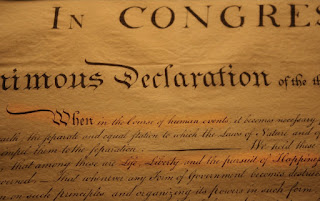
How about we do something novel in the new year? Let's stop worrying about the stuff most politicians, pundits, and activists want us to worry about and instead think about ourselves, our families, our friends, and whatever communities we choose to be part of. Let's forget about "the country" and the rest of the world. Let's individually pursue happiness.
All I'm saying is that it's finally time for the politicians, bureaucrats, and know-it-all intelligentsia, left or right, to get out of the way and let us set our own agendas.
Too self-centered? Well, too bad. Much evil results from people failing to mind their own business. But what I have in mind does not involve wishing other people ill or seeing life as a zero-sum game in which you can win only if others lose. On the contrary, we benefit from other people's, including distant strangers', good fortune because at the very least it opens up opportunities for mutual gains from trade. ("The division of labor is limited by the extent of the market," the wise Adam Smith pointed out some time ago.) In reality, it opens up so much more.
There's little chance this sort of world would result in what is often stigmatized as "selfishness." The vast majority of us understand that truly caring about oneself necessarily means caring about other people in a variety of proper ways. In fact, the person who claims to care only about himself actually cares little even about himself. That's why mutually beneficial social arrangements have been bottom-up affairs. As Thomas Paine recognized in The Rights of Man:
Great part of that order which reigns among mankind is not the effect of government. It has its origin in the principles of society and the natural constitution of man. It existed prior to government, and would exist if the formality of government was abolished. The mutual dependence and reciprocal interest which man has upon man, and all the parts of civilised community upon each other, create that great chain of connection which holds it together. The landholder, the farmer, the manufacturer, the merchant, the tradesman, and every occupation, prospers by the aid which each receives from the other, and from the whole. Common interest regulates their concerns, and forms their law; and the laws which common usage ordains, have a greater influence than the laws of government. In fine, society performs for itself almost everything which is ascribed to government.
Yet the policy elite and much of the ideological left and right don't want us to understand this. They have other plans for us. They always do, don't they? So they can't let us get it into our heads that their agendas are illiberal impositions.
The ruling establishment and its mouthpiece media try to keep us agitated by a variety of threats. As Ted Galen Carpenter notes,
In recent years, U.S. executive branch officials and members of Congress from both political parties have routinely portrayed Russia or China (and frequently both countries) as existential threats to the United States. It also is becoming increasingly common to find news articles or opinion pieces that adopt the same theme. Moreover, a significant number of politicians and analysts put smaller powers, especially Iran and North Korea, and even non-state actors, such as Al Qaeda and ISIS, in that category. The concerted campaign on the part of opinion-shaping elites to hype the danger from such sources is leaving an indelible mark on public attitudes. Many Americans now believe that their country faces multiple, horrifying threats.
More sober reflection should cause the public to conclude that the dangers are greatly exaggerated, and that the individuals, agencies, and organizations that foster such hysteria are not doing the country any favors. ("Paranoid Superpower: Threat Inflation is the American Way.")
Do the real or imagined threats to Ukraine or Taiwan really represent existential threats to the world including the American people?
Then there's the so-called climate emergency, which doesn't exist. After more than 40 years of the most ridiculously bad predictions of the imminent catastrophe, it's time for those who still take the doomsday scenarios seriously to realize that "Wolf!" has been cried too many times. The same goes for other "crises," like the ones supposedly presented by immigrants, global free trade, and the allegedly rampant racism, sexism, anti-Semitism, and the assortment of imagined phobias.
We can also tell the "woke" left and the national conservative right that we have our own lives to live, thank you very much. And, no, we don't have too much freedom, no matter what they may think. They can include us out of their culture wars.
The point of freedom is to be left unimpeded in our own individual and voluntary cooperative pursuits. It will forever be remarkable that the Declaration of Independence specified "the pursuit of happiness" in its examples of unalienable rights. Let's never forget it.
Meanwhile, Happy New Year!
Thursday, December 30, 2021
Feelings and Explanations
We frequently conflate feelings with explanations of feelings. It's important that we not do that.
From the fact that people are infallible authorities on whether they experience, say, pain, it does not follow that they are infallible authorities on why they experience pain on any particular occasion. They can't be wrong about the former, but they surely can be wrong about the latter. It would make no sense to say, "I thought I was in pain last night, but I was wrong." Yet it would make perfect sense to say, "I thought my mouth hurt because of a cavity, but I was wrong. The source of the pain was my right temporomandibular joint. The connection between effect and cause is even looser with things like anxiety. One might feel apprehensive or dysphoria generally, but how does one pin down the precise cause with confidence?
People of course can lie about being in pain, or not being in pain, but that is beside the point. I assume sincerity here.
So imagine someone suffering distress because, despite his homo sapiens body, he sincerely believes that his real species identity is that of an extraterrestrial. That is, he was "given the wrong body" and mistakenly "assigned" to the category homo sapiens. How does he know? He says he feels like an alien and doesn't feel like a human being. He also insists that his explanation must be correct because only he has direct and perfect knowledge of his own identity. Therefore he demands that everyone not only acknowledge it but also really believe it.
Leaving aside some serious problems (what does it mean to feel like an alien or for that matter a human being?), a rational person could take his claim of distress at face value while rejecting his explanation as wrong and even absurd. Expressions of doubt about, not to mention the outright rejection of, his explanation might hurt that person's feelings, yet that would be no reason to patronize him by pretending to take the explanation seriously. If he reacted to the doubters and "deniers" as phobic bigots and exclusionists who ought to be drummed out of enlightened society, he would be the irrational one. One can certainly sympathize with people who suffer without being committed to embracing their explanations for their suffering. We all have the moral (not to mention legal) right to judge the plausibility of explanations for ourselves.
Needless to say, the sort of person I have in mind should have the same rights as everyone else, which boil down to the right not to be aggressed against. People should be legally free to aspire to any identity they want. But identity is always a two-way street; it's a social phenomenon. And that means that other people have rights too. If those others find the positive obligations being expected on them unreasonable (such as the obligation to accommodate a self-identified extraterrestrial and to recognize that person as such), they have a right to say, "Sorry, but no. Live and let live applies to you too."
We cannot show respect for others by adopting their reality-defying fantasies. Sensitivity to suffering does not require us to check our common sense, our logic, and our reason at the door.
Friday, December 17, 2021
TGIF: Double-Rigging of the Auto Market
U.S. government interference with our lives often resembles a Russian matryoshka doll: regulation is nested in more regulation. Take the provision of Biden's pending Build Back Better bill that would create a big tax credit for people who buy U.S.-built electric vehicles (EV).
Not only would the government distort the domestic auto market by rigging it in favor of electric vehicles over conventional ones, but it also would rig the EV market, Trump-style, in favor of U.S.-made products. This implies that "foreign" EVs are so attractive to American buyers that the domestic offerings need help from the state to compete. That's an argument against the provision right there. If the vehicles that American companies and workers turn out aren't what American buyers would want to buy without subsidies, the manufacturers shouldn't be protected from that important information.
Why not? Because markets exist for consumers and not for producers. Makers of trade policy have no political incentive to operate on that principle because manufacturers of a given product can easily organize for government protection of their livelihoods and reward the politicians who do their bidding. Unfortunately, the same cannot be said for consumers, who have too many other things to worry about. Any kind of trade restrictions hurt them because prices will be higher and product variety will be constrained, especially if a trade war breaks out through tit-for-tat retaliation.
Trade wars end up hurting producers as well, of course. Even without a trade war, when Americans buy less from foreigners, foreigners, having less money, will buy less from Americans and other foreigners. The bad effects ripple globally.
Understandably, electric-vehicle makers in Canada and Mexico are especially upset. Who could blame them? The San Diego Union-Tribune reports, "Canada and Mexico worry the provision would lead to dramatic reductions in EVs purchased in their respective countries and violates the U.S.-Mexico-Canada Agreement, or USMCA, the trade pact the three countries passed last year to replace NAFTA."
So much for the alleged free-trade zone of North America.
But things are not quite so simple as the provision's backers make out, demonstrating that Donald Trump had no monopoly on willful ignorance about the reality of trade. The inhabitants of the United States, Canada, and Mexico do more than trade finished consumer goods with each other. For many years North America has been a single highly integrated market for producers' goods.
According to the Union-Tribune, Canada's consul general for Southern California, Nevada, and Arizona, Zaib Shaikh, points out that, in the newspaper's words, "Determining the country of origin of a given vehicle is complicated because the auto industry of the three North American countries has become so highly integrated."
In other words, It's not clear what an American, Canadian, or Mexican EV is exactly. “'When you think about vehicles assembled in Canada, they’re actually 50 percent U.S.-made,' Shaikh said, 'because the supply chain works so that things are crossed over six or seven times across the border' before a vehicle is finally assembled."
It's hardly the first time that the authors and backers of legislation were ignorant about the thing they sought to regulate.
As already noted, tilting the market toward American manufacturers, even if that were possible today, is not the only objectionable feature of the provision. The provision also aims at tilting the market toward EVs and against vehicles with internal combustion engines. EV purchasers would gain $12,500 in tax credits by 2027. This is in pursuit of the Biden administration's goal of cutting carbon-dioxide emissions 50-54 percent from the 2005 level by 2030 and reaching net-zero emissions across the economy by 2050.
Those targets are important for many people on the fallacious grounds that carbon dioxide is a pollutant that is ruinously warming the climate when in fact it is plant food that is greening the earth and bringing other palpable benefits to mankind. (Thanks to technology, the real pollutants in gasoline are already controlled in today's clean cars.)
To the extent that human-generated CO2 emissions through the use of fossil fuels have contributed to mild global warming since the Industrial Revolution began, they have helped to improve the lives of human beings everywhere by making the natural world more hospitable. During this time, population, life expectancy, and per-capita wealth have grown, while extreme poverty, infant mortality, and deaths from weather extremes have plummeted. Cold kills more people than heat, and the longer growing seasons made possible by warming help feed the world's nearly 8 billion people at a lower cost.
For the foreseeable future, nothing will be able to compete with fossil fuels in providing reliable, inexpensive, and abundant energy -- something billions of people in the developing world desperately need if they are to achieve the living standards that we in the West take for granted.
So rigging the market in favor of electric vehicles is a dumb idea.
Finally, we might welcome tax credits because they provide a chance to keep more of our money, but this principle is a snare and a delusion. The power to tax (that is, steal) is bad enough without it also being a politician's tool to manipulate market outcomes. That only adds injury to injury.
Friday, December 10, 2021
TGIF: Joe Biden, Let's Not Go to War with Russia
Here's a good idea: let's not go to war against Russia. Let's not even rattle a saber at Russia (or China, for that matter) because even wars that no one really wants can be blundered into. Many losers would be left in the aftermath, even if nuclear weapons were kept out of sight, but no one would win. So as that smart Defense Department computer says in the 1983 movie WarGames, "The only winning move is not to play."
The crisis du jour is Ukraine; before that, it was Georgia, both former Soviet republics. For some inexplicable reason, Russia's rulers get nervous when the U.S. foreign policy elite treats Russian historical security concerns as of no consequence. Could it have something to do with the several invasions of Russia through Eastern Europe in the past? Jeez, from the way the irrational Russians behave, you'd think their American counterparts never invoked U.S. security concerns (usually bogus) as a reason for military action. As if...
But maybe it is time for America's rulers to take Russian worries into consideration. Even for those of us who are no fans of Vladimir Putin and the government he runs, this seems like good advice – if for no other reason than narrow American self-interest. At least, that's how it looks from the view of regular Americans, who might appreciate for a change what Adam Smith described as "peace, easy taxes, and a tolerable administration of justice."
Anyone who has paid attention to U.S. foreign policy since the peaceful dissolution of the Soviet Union and its Warsaw Pact alliance, 1989-91, would realize that America's bipartisan foreign-policy elite has taken precisely the wrong tack by baiting nervous Russian nationalists at every turn. Despite promises to the contrary, that elite has led the charge to add members to the NATO alliance, taking the anti-Soviet military and political organization right up to the Russian border and staging military exercises uncomfortably close. The U.S. has also sold weapons systems to NATO-member Poland, formerly a member of the Warsaw Pact.
Putin insists that NATO not expand any further, but Biden told him to shut up. The U.S. position is that NATO's inclusion of former Soviet possessions is purely an alliance affair. Meanwhile, Biden threatens more harsh economic sanctions and even more U.S. troops to Eastern Europe if Putin doesn't acquiesce by, among other things, moving his troops away from the Russia-Ukraine border
Let's also recall that in 2014 the U.S. stood behind a neo-Nazi-supported coup against an elected, Russian-friendly president in Ukraine, knowing full well how the Russians would react. Fearing U.S./NATO encroachment, Putin's government annexed Crimea with its strategic warm-water Black Sea naval base, which has been part of the Russian security system for over 200 years. Nevertheless, and most relevant to today's heightened tensions, Putin declined an opportunity to annex eastern Ukraine (the Donbass region full of ethnic Russians ) when a majority there voted for independence from Kiev.
You didn't have to know too much about European history to see how provocative the U.S.-sponsored regime change in Ukraine would be. To make matters worse, Ukraine and Georgia have become de facto NATO members, but only because the U.S. elite has not yet convinced its European counterparts to give those two former Soviet republics official membership. That, however, hasn't stopped Washington from extending a security guarantee to Ukraine that is all too much like the one that NATO members extend to one another. Biden has just reinforced that guarantee.
Which Americans are ready to die for Kiev?
For some reason it's easy for Americans, who can be as nationalistically self-centered as anyone, to assume that any ratcheting up of tensions with Russia must be the Russians' fault. The establishment media have no problem presenting this as an indisputable fact. But how do they know it's true? They never furnish evidence. Foreign-policy expert Ted Galen Carpenter of the Cato Institute has a much more evidence-bound take:
Moscow’s behavior has been more a reaction to aggressive moves that the United States and its Ukrainian client have already taken than it is evidence of offensive intent. Russian leaders have viewed the steady expansion of NATO’s membership and military presence eastward toward Russia’s border since the late 1990s suspiciously and they have considered Washington’s growing strategic love affair with Kiev as especially provocative.
Moreover, Carpenter adds,
Ukraine’s own policies have become dangerously bellicose. The government’s official security doctrine adopted earlier this year, for example, focuses on retaking Crimea, the peninsula that Russia annexed in 2014 following the West’s campaign that helped demonstrators overthrow Ukraine’s elected, pro-Russian president. Statements by President Volodymyr Zelensky and other leaders have been disturbingly bellicose, and Ukraine’s own military deployments have further destabilized an already fragile situation.
Carpenter points out that while the United States is far more powerful than Russia in conventional terms, "unless the United States and its allies are willing to wage an all-out war against Russia, an armed conflict confined to Ukraine (and perhaps some adjacent territories), would diminish much of that advantage. Russian forces would be operating close to home, with relatively short supply and communications lines. US forces would be operating far from home with extremely stressed lines. In other words, there is no certainty that the US would prevail in such a conflict."
Would the Biden administration then back down or go nuclear? Who is eager to find out?
Those considerations aside, the U.S. government should simply stop fanning the Russophobic flames simply because a war would be incredibly stupid.
Friday, December 03, 2021
TGIF: Safety in Freedom
With the emergence of the Omicron COVID-19 variant, renewed restrictions on liberty or calls for their reinstatement have broken out around the world. The new wave is probably only beginning, and with it will surely come sermons on how we must face trade-offs between liberty and safety. This seems to be the new normal.
The usual justifications for this purported necessity always feel inadequate, with gaping holes in the case for expanding government power to extraordinary lengths. Since we all now have a good deal of experience with COVID under our belts, let's hope that the public's doubts about any new power grab will be strong and loudly expressed.
What brought this subject to mind was a recent Oxford Union debate, which I ran across on YouTube. While I've watched only a little, it quickly occurred to me that the case for a necessary trade-off between liberty and safety runs aground with the realization that liberty is a necessary condition for safety. After all, it's not always clear how one can best stay safe in a situation: that requires thought, discourse, action, and therefore liberty.
Moreover, that matter is separate from the question of how safe any particular person may wish to be. Indeed, people have different preferences with respect to risk and safety in part because life is complicated and trade-offs are ubiquitous. Increasing one's safety in some measure by abstaining from some desirable activity will likely require too big a sacrifice for some people, although for others the benefit will be well worth the cost. (A person cannot violate his own freedom.) So who's to decide? Why should a faceless bureaucrat or a charismatic politician make the call?
Few people understand that there's safety in liberty, specifically, the freedom to think, improvise, and innovate. This is true for individuals, but when the potential danger is social or global, the case for liberty is equally clear. That's precisely when we all need many minds searching for solutions without central direction. Knowledge is dispersed, and no one can say who will have a key insight. Competition is the universal solvent. And to be effective, thinking requires freedom of action.
Matt Ridley and Julian Simon before him elaborated how we all benefit from the often unintentional combination of ideas generated in different and unlikely places. By now, the serendipity that freedom produces ought to be expected. The results often are imaginative approaches to vexing problems that few would have dreamed possible.
The case for giving up freedom to acquire a measure of safety is actually an appeal to trust in an anointed central authority. And that means a threat of force is at least implied.
But where is the actual safety in that arrangement? Why should anyone believe that the anointed know what they are doing? They operate in a centralized, bureaucratic environment. The rulers expect the ruled to behave like children who have been told that all will be fine if they obey. Unfortunately, the ruled often think of themselves as children when it comes to the latest risk proclaimed by their rulers.
So are people really safer than they would have been in a free, decentralized, and competitive environment? We find no evidence for this in places that imposed harsh restrictions on liberty in response to COVID-19. Lockdowns, vaccine and mask mandates, and travel bans show no signs of delivering on the politicians' promises. There just is no good substitute for freedom at every level because no central authority is knowledgeable enough.
Finally, what about the risks that individuals might present to others and not just to themselves? There are big differences between 1) the potential risks to others that anyone may pose in simply going about the normal business of life and 2) the dangers produced by aggression, gross negligence, and inadvertent toxic pollution, where identifiable individuals entitled to due process can be shown to present demonstrable peril to others. For one thing, in the first case, people are not passive victims-in-waiting but generally informed agents capable of taking precautions against infection. Imagine the nightmare that would come from the principle that everyone in society may be viewed as a threat to everyone else merely by breathing. We don't have to imagine it, do we? That's how most governments throughout the world -- blunt instruments that they are -- responded to the pandemic. As a result, our livelihoods -- our lives-- are now subject to cancellation without notice.
(Photo credit: Dev Asangbam, Unsplash License)
Friday, November 26, 2021
TGIF: Racial Polarization Is Poison
Be they "left" or "right," those who agitate for racial polarization seem to have no sense of the harm they could do to everyone in our society. As the wise Glenn Loury would say, they are playing with fire. By polarization, of any kind, I mean more than merely a vigorous disagreement over issues or even basic principles. That's fine. Rather, I mean something dogmatic, obsessive, and fanatical, in which virtually everything in the world is seen through a single lens and everyone is expected to act and speak in a certain way, with stern consequences for the noncompliant.
It can happen in politics, but it is becoming especially common with race, where some would have us interpret virtually everything through a racial prism. This is more than simply unfortunate; it threatens what the ancient Greek philosophers and later philosophers such as Spinoza -- whose 389th birthday (Nov. 24, 1632) we marked this week -- held to be the good life for human beings; it's the conception of life in which being virtuous is seen as constitutive of happiness, or better: eudaimonia, and not separate from happiness or merely means to it.
Racial polarization threatens this not just in the obvious way, namely, with the potential holds for violence. I'm thinking of the more subtle way: through the narrowing and undermining of all sorts of social cooperation.
Formulators of the original (classical) liberalism, which has been refined into the libertarian political philosophy, took to heart what the Greeks and their intellectual descendants emphasized, namely, that we human beings are inherently social animals. Some went even further to note that, as reason- and language-bearing creatures, we thrive best when surrounded by people who exhibit their rationality in the fullest sense, not only as a tool to judge means but ends as well. Only in such a milieu can we live in ways most proper to rational animals, that is, with reason always in the driver's seat. This entails, among other things, dealing with people through argument, persuasion, and consent rather than command, manipulation, and force.
A key way that social existence promotes individual flourishing is cooperation, which augments our otherwise weak individual capacities. While no collective brain exists, liberal society creates something analogous to it. As a result, we each gain access to an incredible volume of knowledge -- moral and otherwise -- any morsel of which we might never have thought up or encountered while living alone or in small groups during our limited lifespans. The marketplace of ideas is an example of this process that benefits us all beyond measure. In this day when free speech and free inquiry are increasingly under assault from reckless elements left and right, this would be good to remember.
The benefits of the broadest possible social cooperation are also abundant in the material realm. The early liberal political-economic thought demonstrated that living in isolation was to live in abject poverty. No one was better at pointing this out than Frédéric Bastiat, the 19th-century French liberal. In the opening chapter of his unfinished magnum opus, Economic Harmonies, he wrote:
It is impossible not to be struck by the disproportion, truly incommensurable, that exists between the satisfactions [any] man derives from society and the satisfactions that he could provide for himself if he were reduced to his own resources. I make bold to say that in one day he consumes more things than he could produce himself in ten centuries.
What makes the phenomenon stranger still is that the same thing holds true for all other men. Every one of the members of society has consumed a million times more than he could have produced; yet no one has robbed anyone else....
We should be shutting our eyes to the facts if we refused to recognize that society cannot present such complicated combinations in which civil and criminal law play so little part without being subject to a prodigiously ingenious mechanism. This mechanism is the object of study of political economy.
If this was true in 1850, what would Bastiat say about our time? Think of all the things we have access to in the developed world, even those of modest means. (The people of the developing world want the same, which shows the cruelty of so-called climate policy, which would raise the price and reliability of energy.) The point which shouts from Bastiat's passages is that we have much to lose if social cooperation were to break down or even narrowed. Society is exchange, as the liberals hammered home on many occasions. "Society is concerted action, cooperation," Ludwig von Mises wrote in his grand treatise, Human Action, which he was tempted to call Social Cooperation, another name for specialization through the division of labor and knowledge.
Need more be said about the threat from racial and other deep polarization? To invoke another original liberal, Adam Smith famously wrote that the division of labor is limited by the extent of the market. The fewer the people with whom to cooperate, the more primitive the division of labor. And the more primitive the division of labor, the poorer we are. That should require no elaboration.
When social distrust is sown among groups, particularly on the basis of spurious identity considerations, a great deal of what we value but take for granted is put at risk. This doesn't mean that America's history of slavery, Jim Crow, and less formal forms of racism can't be taught and discussed frankly. They must be. But the cost will be unspeakably severe if frank conversation about the past and even aspects of the present transmogrify into polarization, hatred, and distrust.
Good people everywhere should speak out against polarization. Think about what we all have to lose. And once it's lost, there may be no getting it back.
Tuesday, November 23, 2021
"Coming to Palestine" Discussed on Podcast
I discussed my Libertarian Institute book Coming to Palestine on the podcast The Enragés (a project under the auspices of the Center for a Stateless Society).
Friday, November 19, 2021
TGIF: Rigged Political Language
It's an old trick: gain advantage over others by hiding one's meaning behind euphemisms and other forms of linguistic camouflage and misdirection. People do this in all walks of life, but politicians make careers of it. If they engage in straight talk at all, it is by far the exception. The journalist Michael Kinsley defined a gaffe as "when a politician tells the truth – some obvious truth he isn't supposed to say."
Obfuscation is the currency of politics. Little has changed since Oscar Wilde's time: "Nowadays to be intelligible is to be found out.”
Libertarians have emphasized this scam for years. When they say that taxation is theft, they offer an illustration. If you threatened to harm people, say, by imprisonment, unless they surrendered some of their incomes each year, you would be prosecuted for extortion, even if you planned to do good works with the money. Punishment would then follow. Politicians do the same thing, except that taxation is not illegal.
When the government orders people to leave their homes so politicians may put the land to other uses, that is also theft. But it is called by the high-sounding term eminent domain. That euphemism adds to the mystique of the state as it reveals what ought to be a repugnant idea: that the government is the supreme owner of all land in its jurisdiction -- even in the United States, whose Constitution implicitly embraces that principle. True, eminent domain is not an enumerated power (so much for the doctrine of the limited power), but it is acknowledged indirectly in the clause about compensation in the subsequently added Fifth Amendment. This shows that the framers thought the power to take private property was inherent in the sovereign.
The so-called "takings clause" is an odd part of the Bill of Rights. It proclaims that people have a right to "just compensation" whenever the government violates their right to property. That the government pays what it calls "just compensation" does not make eminent domain alright. What makes compensation just in a normal transaction is that the buyer and seller freely agree to the amount. Since sellers are coerced under eminent domain, no compensation qualifies as just.
If we set our minds to it, we could all find many more examples of political euphemisms. The Department of Defense was once called the Department of War. The term free election disguises the fact that voters choose among politicians under duress: they will be coerced by government policy whether or not they participate in the election. Climate policy ought to be called pro-poverty policy. Trade policy would better be known as crony-reward policy. Government intelligence and military justice ... well, you get the idea.
Scanning the recent headlines, I notice that many places are enacting so-called gun-buyback programs. What a euphemism that is. You would think that the only thing that the government could buy back was something that it had originally sold. That's what back means in such a phrase. But state and local governments don't sell guns to citizens, so how can they buy them back?
I concede that the recent programs appear to be voluntary, although the money paid (sometimes in the form of grocery gift cards) is taken by force from the taxpayers. So the politicians aren't even buying back with their own money. In the past, however, buyback campaigns were mandatory, and some favor compulsion today. For example, Barack Obama and Hillary Clinton spoke favorably about Australia's compulsory program. Beto O'Rourke, who sought the 2020 Democratic presidential nomination, has called for a compulsory "assault weapons" buyback.
Incidentally, the National Bureau of Economic Research recently published a paper (for which I cannot vouch) purporting to demonstrate that gun violence is not reduced in the United States when governments buy and destroy guns turned in by citizens:
Gun buyback programs (GBPs), which use public funds to purchase civilians' privately-owned firearms, aim to reduce gun violence. However, next to nothing is known about their effects on firearm-related crime or deaths. Using data from the National Incident Based Reporting System, we find no evidence that GBPs reduce gun crime. Given our estimated null findings, with 95 percent confidence, we can rule out decreases in firearm-related crime of greater than 1.3 percent during the year following a buyback. Using data from the National Vital Statistics System, we also find no evidence that GBPs reduce suicides or homicides where a firearm was involved. These results call into question the efficacy of city gun buyback programs in their current form.
This isn't surprising. People with violent intent aren't likely to sell their guns "back" to the government.
At any rate, we ought to be clear about what we call these programs. Governments demonize guns (rather than bad users of guns) by bribing people with stolen money.
We might actually roll back government power if the exercise of that power were not systematically obscured by euphemisms.
Subscribe to:
Posts (Atom)